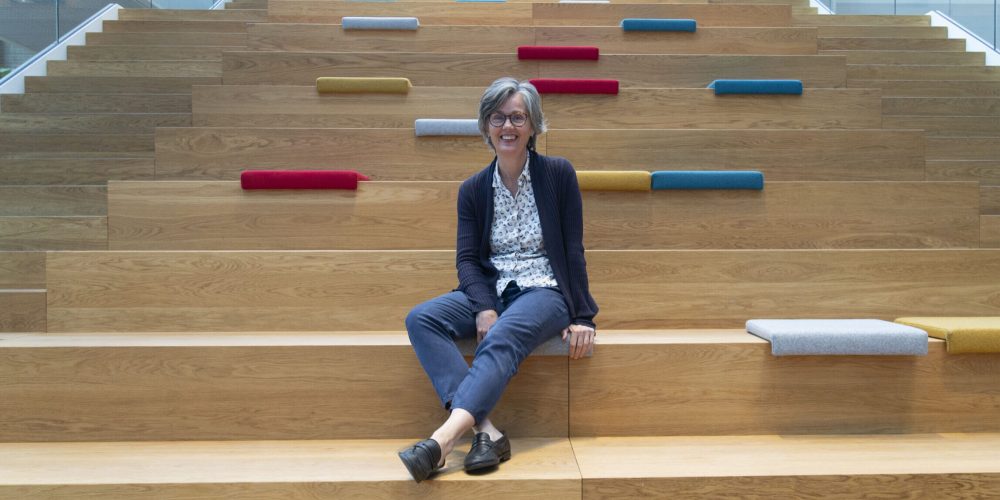
When Barbara Terhal began her PhD in Amsterdam in 1995, quantum computing was a field small enough to fit in a single workshop room. Thirty years later she is back as QuSoft’s 2026 Turing Chair, and she is one of the world’s leading researchers in quantum error correction, the technique that quantum computers need before they can do useful work.
Her month in Amsterdam ends this week with the Workshop on Quantum Error Correction at Amsterdam Science Park (28–30 October), part of CWI’s research semester programme on quantum algorithms and quantum error correction. We asked her what has changed since she started, where error correction meets QuSoft’s work on quantum software, and what she would tell students thinking about entering the field.
A small, mixed field
Terhal did her PhD with Paul Vitányi at CWI and Bernard Nienhuis at the University of Amsterdam. “When I started in 1995, the field was very young of course, so very few people working in it, and quite interdisciplinary,” she says. “My first workshop was in Turin, Italy in 1995 and was attended by a small mix of experimental and theoretical physicists, mathematicians and computer scientists.”
The field has grown enormously since then, and one sign of that growth is QuSoft, the Amsterdam research institute for quantum software. That mix of disciplines is what Terhal thinks is most worth protecting. “It is important that we keep making the connections between ‘the practical and the mathematical’ even though the field has grown so large now.” Bringing people from different communities together is not easy, she adds: “It can be challenging to bring people together from different communities, which is why it is important to do.”
Protecting fragile information
Terhal explains error correction with everyday examples. “Errors and faults occur in most processes, whether it is a CD getting scratched or DNA being altered while it gets copied. To preserve information, mechanisms for error correction thus need to be in place. For quantum information, due to its fragility as compared to classical information, quantum error correction is a necessity at the most basic physical level.”
The quantum version is harder than the classical one. Quantum information cannot simply be copied, and looking at it directly disturbs it. Quantum codes therefore spread one unit of information across many physical qubits and detect errors indirectly, without reading the information itself. “The last, say, 5 years have seen a lot of progress in experimental quantum error correction, with much more progress to come,” says Terhal.
Between software and hardware
This is where her work meets QuSoft’s. “Quantum error correction sits right in between quantum software and quantum hardware in the quantum computer stack,” she says. “Every algorithm has to be translated to its implementation in a code architecture whose design uses hardware specifications and capabilities. Therefore I believe there is a lot of important work to do at the boundary between quantum algorithms and quantum error correction.”
Some of that work, she thinks, belongs in industry. Since 2025 Terhal has combined her professorship at TU Delft and QuTech with a research fellowship at Riverlane, a company that builds error-correction software. “Companies can make fast progress by work being done in teams with great focus,” she says. “For example, quantum error correction requires a lot of software development, as measurements which detect errors are processed using this software.” In her view, a company environment may be better suited to designing the quantum computer as a whole: “the design for logical processing units, memory and storage, all using QEC, and how this impacts and optimises the running of algorithms.”
A month in Amsterdam
During her stay Terhal gave the department colloquium of the Korteweg-de Vries Institute for Mathematics on 14 October and spent time with QuSoft researchers discussing questions in quantum algorithms, conversations she hopes will continue.
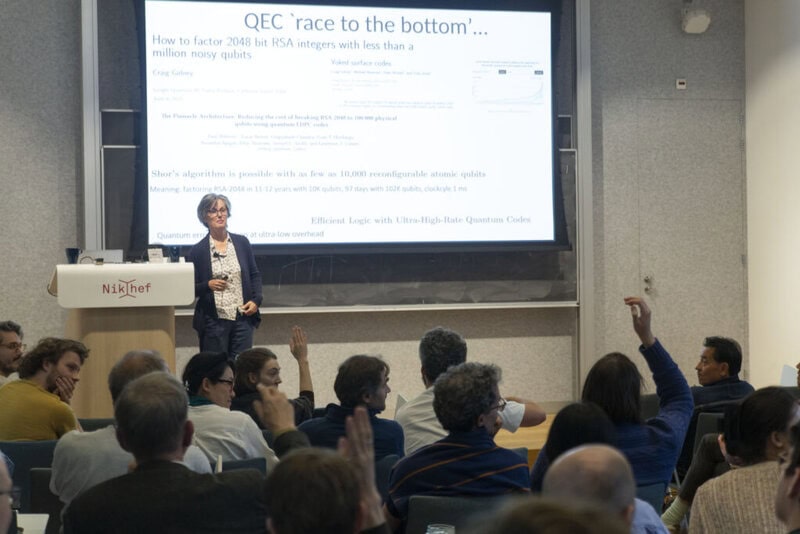
At this week’s workshop she is keen to hear the latest on one of the field’s open problems. She hopes “to learn more about logical gate constructions for LDPC codes.” LDPC codes are a family of error-correcting codes that could protect quantum information with far fewer physical qubits than today’s standard approaches. Storing information with them is well understood, but computing on that protected information is still an active research question.
Advice for students
Her advice to students is candid. “Quantum error correction has become a very popular field of research, at times it feels a bit overcrowded,” she says. “However, it is fun to connect with quantum hardware, the research can be quite hands-on/numerical, but there are also beautiful & fascinating mathematical aspects of quantum error correction research. So there is a bit of everything.”
About the Turing Chair
The Turing Chair is a rotating honorary position at the Faculty of Science of the University of Amsterdam, associated with QuSoft. Previous Turing Chairs include Gilles Brassard (2020–2023) and Matthias Christandl (2024). Read the announcement of Barbara Terhal’s appointment.
Photos: Paul Roberts (CWI)