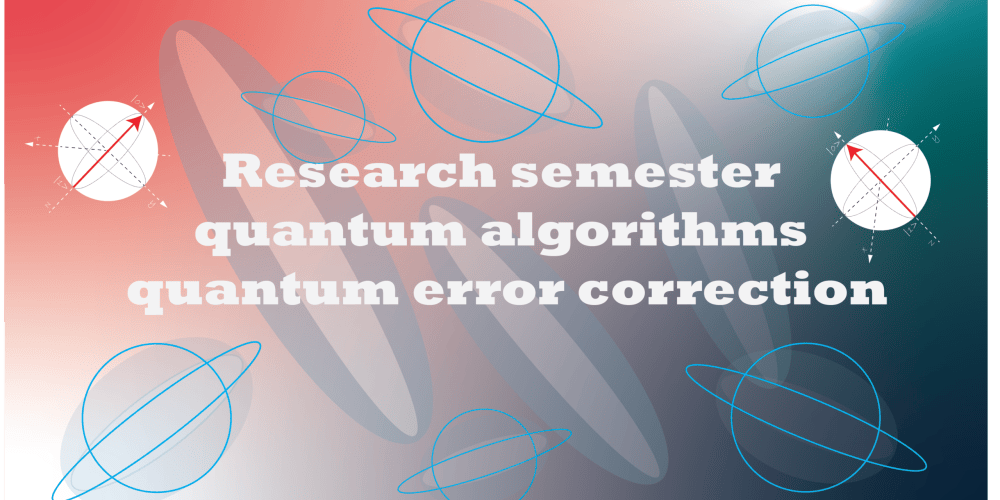
Registration is now open for a new research semester program, which will comprise an initial summer school followed by two dedicated research workshops. The program centers on two foundational pillars of QuSoft’s research agenda: Quantum Algorithms and Quantum Error Correction. Over the course of the semester, these topics will be examined from their core principles up to current state-of-the-art advancements. The primary objective of these gatherings is to provide a structured environment that encourages new theoretical insights, facilitates academic collaborations, and develops future research directions in quantum software.
Interested participants can now register for the upcoming sessions:
- 24-28 August, summer school on QA and QEC
- 16-18 September, workshop on QA
- 28-30 October, workshop on QEC
Quantum error correction
Quantum error correction (QEC) is a very active field of research, dominated on the one hand by practical considerations and on the other hand by the theoretical construction of novel codes. In state-of-the-art quantum computing, a distinction is made between physical and logical qubits. The first correspond to physical systems, while the second refers to a superstructure of many physical qubits needed to minimize noise so that the information is robust and usable. In the case of neutral atoms, one can implement this on a planar lattice of physical qubits. These qubits sit at the vertices of hexagonal or octagonal “tiles” which act as the error-checking stabilizers, while the colorings are used to track errors. Besides color codes implemented in neutral atoms, notable examples of recent significant progress include Floquet codes and “good” quantum Tanner codes.
Quantum algorithms
By developing quantum algorithms (QAs), we explore which computational problems are amenable to quantum speedups. The field has advanced significantly since Shor’s algorithm put it in the spotlight. Although we strive to discover more such examples, achieving even super-quadratic speedups remains a challenging task. Moreover, there are still seemingly basic combinatorial problems, such as finding triangles in a graph, for which we are uncertain how much help a quantum computer will be. To better understand which computational tasks can be accelerated, it is crucial for researchers to keep their toolkit of quantum algorithmic design paradigms up-to-date.
This research semester is organised by Jonas Helsen (CWI), Sebastian Zur (IRIF, CWI), Sander Gribling (TiU), Dmitry Grinko (UvA), and Subhasree Patro (TU/e). The workshop has received support from CWI, the Dutch Research Council (NWO/OCW), as part of the Quantum Software Consortium and the Challenges in Cyber Security, and from Quantum Delta NL.